
ExtremeXP Framework Components
The ExtremeXP framework is built as a modular and interoperable ecosystem designed to support the full lifecycle of continuous adaptive experimentation, integrating human-in-the-loop processes and advanced data-driven decision making.
Framework Architecture Overview
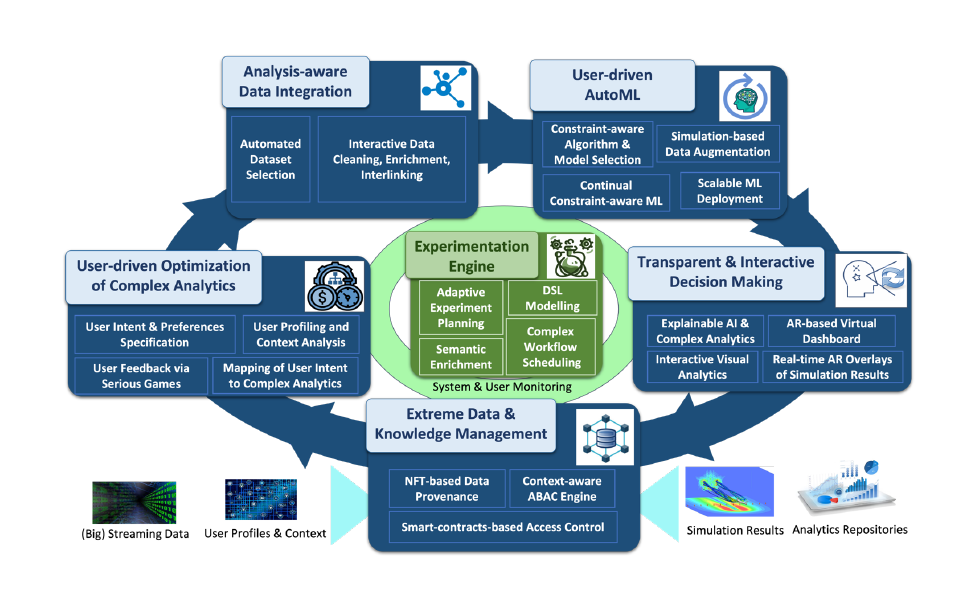
ExtremeXP delivers a comprehensive and modular framework for next-generation continuous adaptive experimentation by combining experiment design, execution, data management, monitoring, and explainability. Below are the main components of the ExtremeXP framework.
Core Components
The ExtremeXP Portal serves as the primary entry point for all ExtremeXP users. Registered users can design and specify workflows and experiments using both :
A Graphical Editor (Experiments tab)
A Textual Editor (Tasks tab, also referred to as the DSL Editor)
The portal centralizes experiment design and provides seamless access to both visual and textual specification tools.
The Experiment DSL Language Server provides syntax and grammar validation for the ExtremeXP DSL directly within the user’s preferred development environment.
Architecture
Server side
Implemented using XText
Runs in Java
Client side
Editor integrations for Visual Studio Code and IntelliJ IDEA
This component ensures reliable, consistent, and error-free experiment definitions.
The ExtremeXP Experimentation Engine is the core component responsible for implementing continuous adaptive experiment planning. It enables researchers and data scientists to :
Define experiments using a simple Domain-Specific Language (DSL)
Execute workflows across multiple backends :
ProActive Scheduler
Kubeflow Pipelines
Local execution
Manage datasets via :
Local storage
Decentralized Data Management (DDM)
Track experiment metadata and results through the Data Abstraction Layer (DAL)
Support human-in-the-loop interaction workflows
The Decentralized Data Management (DDM) component provides a distributed data management system tailored for ExtremeXP, ensuring robust data transport, validation, and insight generation.
Key technologies
Zenoh nodes for decentralized data transport and querying
React frontend
Flask backend
Celery task management
PostgreSQL storage
Ollama integration for dataset-driven insights
Great Expectations for dataset validation
YData Profiling for automated data profiling and reporting
The operation of the ExtremeXP framework requires access to an instance of the ProActive Scheduler, which enables distributed execution of experimental workflows.
Licensing
A separate license from Activeeon is required
An official request must be sent explaining:
Why the license is needed
Who will use it
For what purpose
Technical requirements
Minimum hardware: 4 CPU cores, 8 GB RAM
Minimum RAM usage: 4 GB
Public IP required
TCP ports: 8880 and 33647
ExperimentLens is a lightweight yet powerful visual dashboard for interactive exploration, monitoring, and explainability of complex AI pipelines.
Developed within the ExtremeXP project, ExperimentLens enables researchers, data scientists, and engineers to :
Monitor pipeline lifecycles
Explore results across multiple experimental runs
Inspect configurations and outputs
Gain insights into pipeline behavior and sensitivity
The tool is strongly centered on human-in-the-loop experimentation.
Intents2Workflows translates high-level user-defined analytical intents into actionable and executable workflows.
Process
The user defines an analytical task at a high level
Key features are extracted from the description
The intent is mapped to a rich knowledge base
Ontology-based dependency tracing generates workflows
Workflows are initially encoded in RDF
RDF workflows can be translated into other representations, such as the DSL required by the execution engine
This component provides high flexibility and automation in workflow generation.
- Resolve entities in real-time across heterogeneous and multi-source datasets.
- Leverage attention-based language models to achieve high-precision matching.
- Accelerate deduplication workflows by up to 10x using optimized meta-blocking techniques.
- Optimize resource allocation through the use of clean, unified datasets for critical decision-making.
Optional Components
- a gamification engine, that enables the connected user to display 4 types of dashboards:
- trophees and rewards for all metrics for each experiment, with a manual filter for each experiment,
- a ranking of all experiments, with a manual filter for each metric,
- a ranking of all users of the selected use case, with a manual filter for each metric,
- a reward configurator, accessible only to gamification managers that enables them to configure the rewarding rules.
- API connectors, that connect the gamification module to the metrics API, to retrieve the metrics from each experiment and display them according to parameters configured by the gamification manager.
Experiment Cards are a knowledge management and documentation component designed to support reproducible AI experimentation. By integrating automatically collected metadata with human-in-the-loop input, Experiment Cards document essential experimentation aspects such as intent, constraints, evaluation metrics, outcomes, and lessons learned. They address the limitations of existing documentation approaches, such as Model Cards and Data Cards, which primarily describe static AI artifacts and fail to represent the dynamic and iterative nature of experimentation. Moreover, current practices often overlook the importance of systematically reusing knowledge generated across experimental cycles, leading to fragmented or lost insights.
Functionally, Experiment Cards provide a unified view of experiments and a querying mechanism over executed experiments. They capture experimentation throughout its lifecycle both automatically, via technical components of the ExtremeXP platform when available, and through user interaction.